The short
Must Read Books for AI Engg. · Neeraj Walia (ezSnippet) · 5 Oct 2026 · Watch on YouTube ↗
What he says, in English
The short is in Hindi. I ran the audio through Whisper and put it into plain English. This is a close rendering, not a word-for-word copy.
Two books I ordered for myself. If you are genuinely serious about AI, look at these.
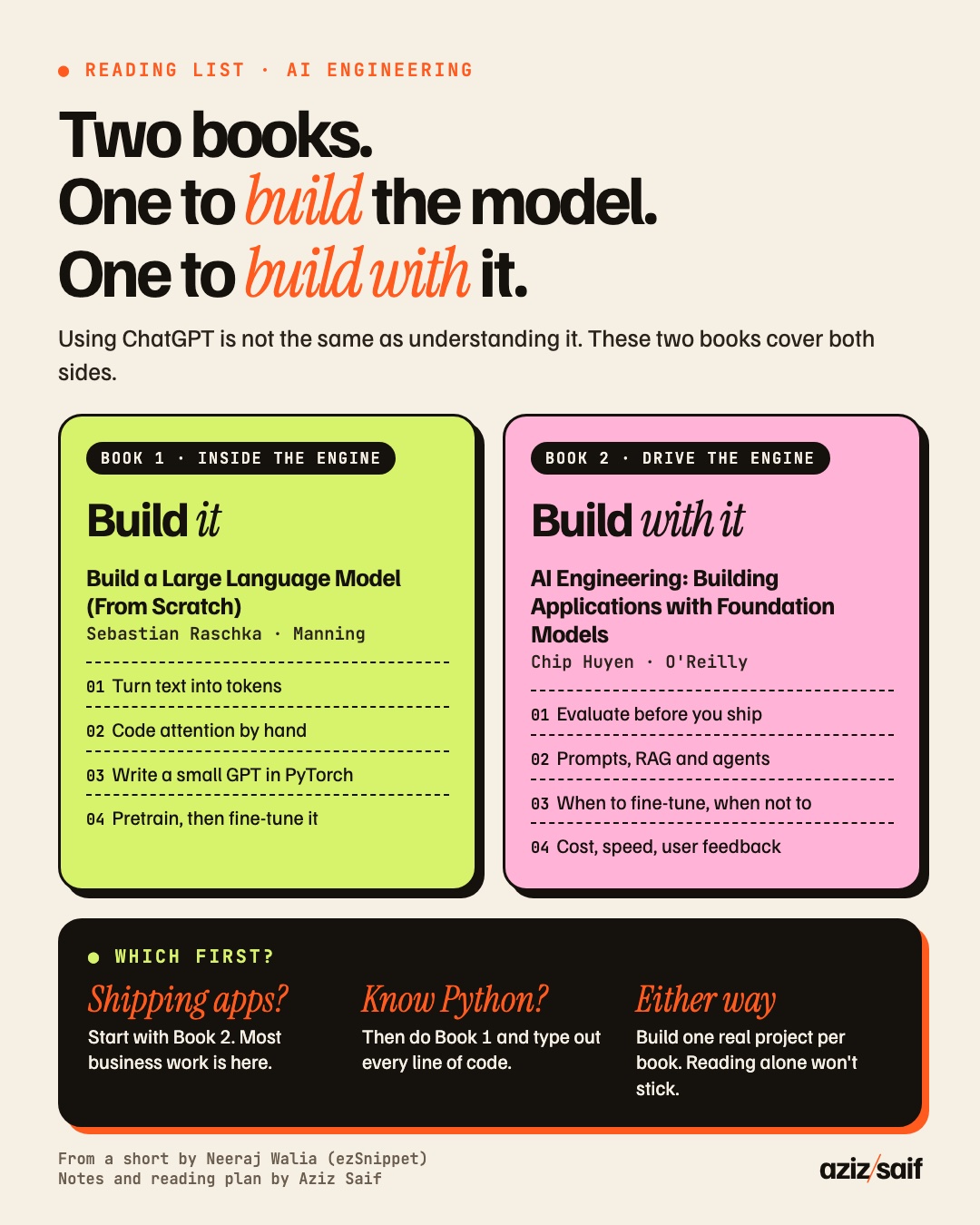
Book one is Build a Large Language Model (From Scratch) by Sebastian Raschka. You learn how to make a model like ChatGPT yourself.
So you understand how ChatGPT was built. Not how to use it, how to actually build it.
Book two is AI Engineering: Building Applications with Foundation Models by Chip Huyen.
It is about taking the big models, ChatGPT, Claude and the rest, and using them to build real apps.
Both are must-reads. Follow for more.
Not how to use it. How to actually build it.The one line that matters in the short
The infographic
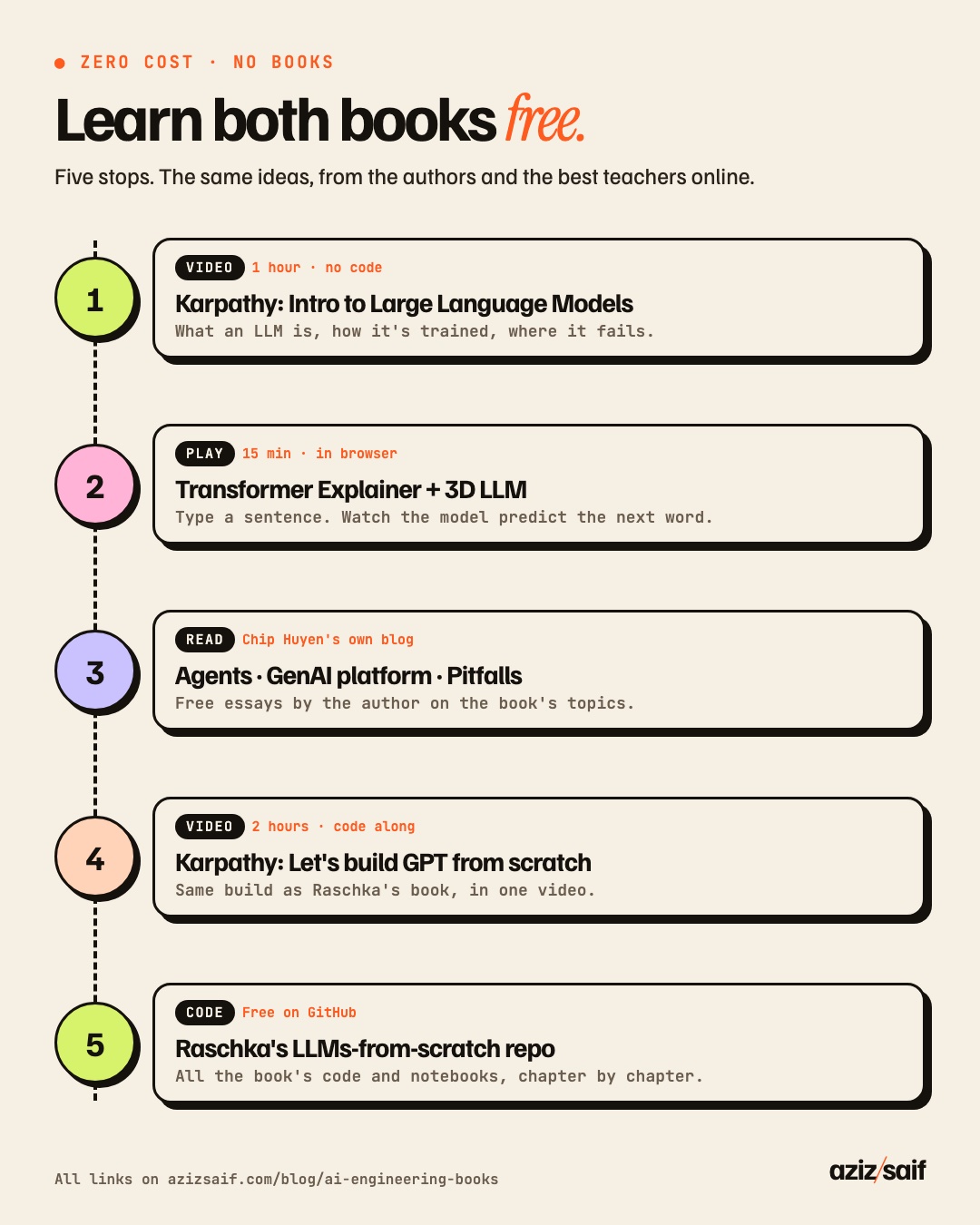
Don't want to buy the books? Learn it free.
1 · Intro to Large Language ModelsAndrej Karpathy · 1 hour · no code. Start here.
2 · Let's build GPT: from scratch, in codeAndrej Karpathy · 2 hours · code along. Same build as Raschka's book.
Free instead of Raschka's book
Free instead of Huyen's book
What is inside
01 Build a Large Language Model (From Scratch)
Sebastian Raschka · Manning, 2024. Write a small GPT in Python, piece by piece. Runs on a laptop.
Who it is for: developers and data people who know Python and want to see inside the engine. Skip it if you have never written code.
02 AI Engineering: Building Applications with Foundation Models
Chip Huyen · O'Reilly, 2025. Build useful apps on GPT and Claude: testing, prompts, RAG, agents, cost.
Who it is for: anyone shipping AI at work. Engineers, product leads, and analysts who build with ChatGPT or Claude every day.
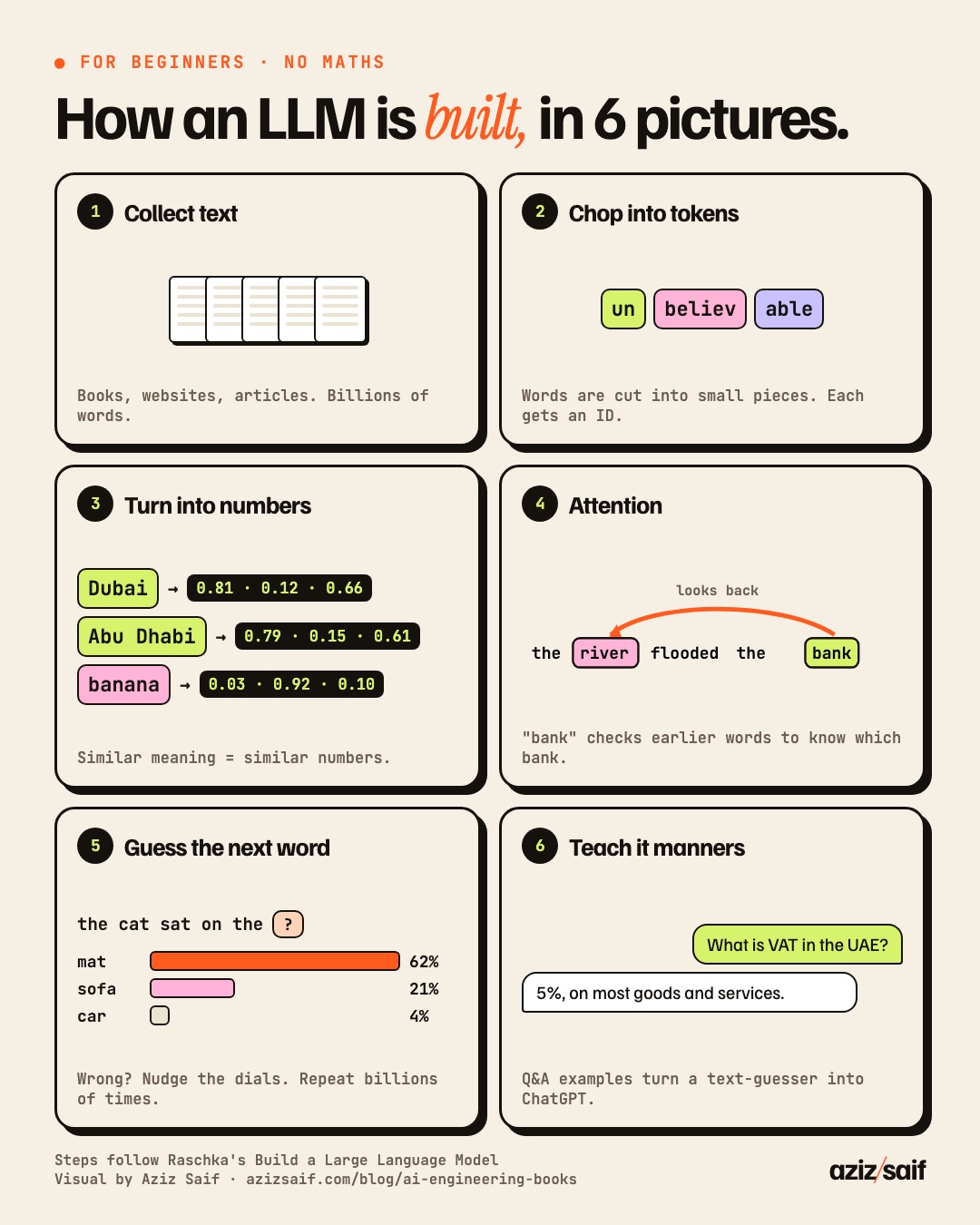
How an LLM is built, in 6 pictures
An LLM reads some words and guesses the next one. That's all. Here is how it learns to guess well.
See the smallest possible language model (a few lines of Python) ›
text = "the cat sat on the mat the cat ate the fish"
words = text.split()

# count which word follows which
nxt = {}
for a, b in zip(words, words[1:]):
    nxt.setdefault(a, []).append(b)

# "generate": always pick the most common next word
w = "the"
for _ in range(5):
    print(w, end=" ")
    w = max(nxt[w], key=nxt[w].count)
It prints the cat sat on the. It only looks back one word. Steps 3 to 5 are how a real model looks back over a whole page.
What a beginner needs
How I would read them
Each week ends with something you built. Use the free links above if you skip the books.
Which first?
Book 2 first: AI Engineering, four weeks
Then Book 1: Build an LLM, four weeks
New to all of this? Start with my roadmap first: How to become an AI engineer in 2026 ↗
Common questions
Which two books does the video recommend?
Build a Large Language Model (From Scratch) by Sebastian Raschka, published by Manning, and AI Engineering: Building Applications with Foundation Models by Chip Huyen, published by O'Reilly.
Which book should I read first?
If you want to ship AI apps at work, start with Chip Huyen. If you know Python and want to see how ChatGPT-style models work inside, start with Raschka. Most people in business get value faster from Huyen.
Can I learn this without buying the books?
Yes. Raschka's full code is free on GitHub, Chip Huyen publishes free essays and chapter notes, and Andrej Karpathy's two YouTube videos cover the same ground. All links are on this page.
Can a beginner build an LLM?
Yes, a small one. With basic Python and a free Colab notebook you can build and train a tiny GPT on a short book in about eight weeks. It won't match ChatGPT, but you will understand how ChatGPT works.
Do I need to code for the Raschka book?
Yes. You need working Python and some comfort with PyTorch or NumPy. The book builds a small GPT model step by step, and its full code is free on GitHub.
Is AI Engineering by Chip Huyen technical?
It is about systems more than code. A manager or analyst can follow most of it. An engineer gets the most out of it.