The video
Al-Ghazali: The Thinker Who Linked Money to Morality · The Financial Historian · Watch on YouTube ↗
Rich, but not yet wise
The setting
Most people trace economic thought to Adam Smith, Karl Marx or Aristotle. This video goes back almost a thousand years. Around 1100 CE, Europe is poor and split apart. The Islamic world runs from Spain to Persia. Baghdad, Damascus and Cairo are rich trading cities, and wealth is growing faster than anyone can make sense of it.
The man
Abu Hamid Al-Ghazali was born in 1058 in Persia. He was a philosopher, a jurist, a theologian and a critic. By his mid-30s he held one of the top teaching posts in the Islamic world. His question was simple. What happens when a civilisation gets rich faster than it gets wise?
Money is a mirror
For Al-Ghazali, money is a tool for exchange. You don't worship it, hoard it or wear it as status. Like a mirror, it has no worth of its own. Its value lies in what it lets people trade, build and do together. He wrote this in the 11th century, when much of Europe still thought of wealth as land or loot.
What he warned about
01 Hoarded money is dead money
Wealth locked in a chest pays no worker and funds no trade. The video quotes him calling it "freezing the bloodstream of society." Hoarding creates scarcity even when resources exist, because the money stops moving.
02 Speculation destroys trust
He had no patience for rigged prices, fake shortages or profiting from a crisis. He called it profit with no contribution. He backed honest trade strongly. His target was cheating: false weights, hidden defects and twisted information.
03 Labour has dignity
Money earned by effort builds character. Money made by manipulation rots it. Societies grow strong when people contribute and weak when they exploit.
04 Debasing the coin is theft
Rulers diluted gold and silver coins to stretch their budgets. That is a tax by stealth. It hit the poor hardest and broke trust in the market. He predicted people would drop a debased coin for a stronger foreign one.
05 Corruption flows downhill
When a ruler cheats, merchants feel free to cheat their customers. Distrust runs from the palace treasury to the street market. A society can survive poverty, but it cannot survive corruption.
Where justice is lost, prosperity cannot remain.Al-Ghazali, as quoted in the video
It reads like today's news
The video lines his warnings up against the present. Hoarding looks like the debate on billionaires and offshore accounts. Speculation looks like housing bubbles and crypto swings. Debasement looks like inflation and the fight over monetary policy. People fleeing a weak coin played out in Weimar Germany, Zimbabwe, Venezuela and Argentina.
He also understood people. They hoard out of fear, speculate out of greed and cheat when they think nobody will notice. So you cannot fix an economy without fixing the incentives behind those choices.
The closing point is the one I keep. Economies rarely collapse because the numbers stop adding up. They collapse when people stop trusting each other. Money is not a machine. It runs on trust.
The rules I took from it
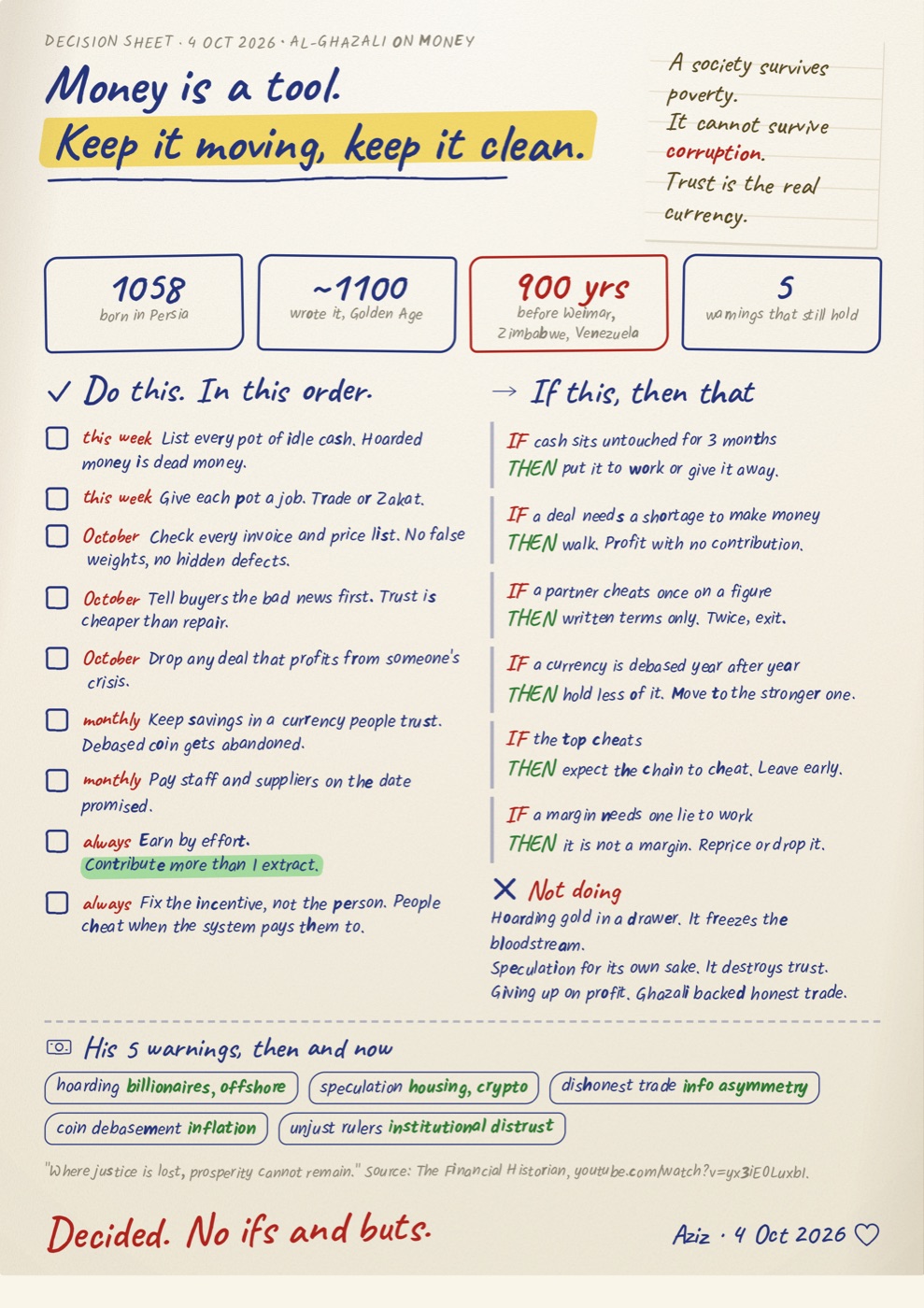
I turned the video into a one-page decision sheet for my own money and business. Nine things to do, six IF / THEN rules, and three things I will not do.