Mohamed Alabbar, minute by minute: failure, discipline, debt and AI
The man behind Emaar and the Burj Khalifa spoke for 19 minutes with Hadley Gamble at the 1 Billion Followers Summit in Dubai. These are the 17 moments worth knowing, each with the minute so you can jump straight to it.
The moment map
Click a time to open the video at that point. Orange is business, green is AI, grey is his opinions on politics and the world.
| # | Time | What he talked about |
|---|---|---|
| 1 | 0:09 | Your brand and your name are everything, and they are long term |
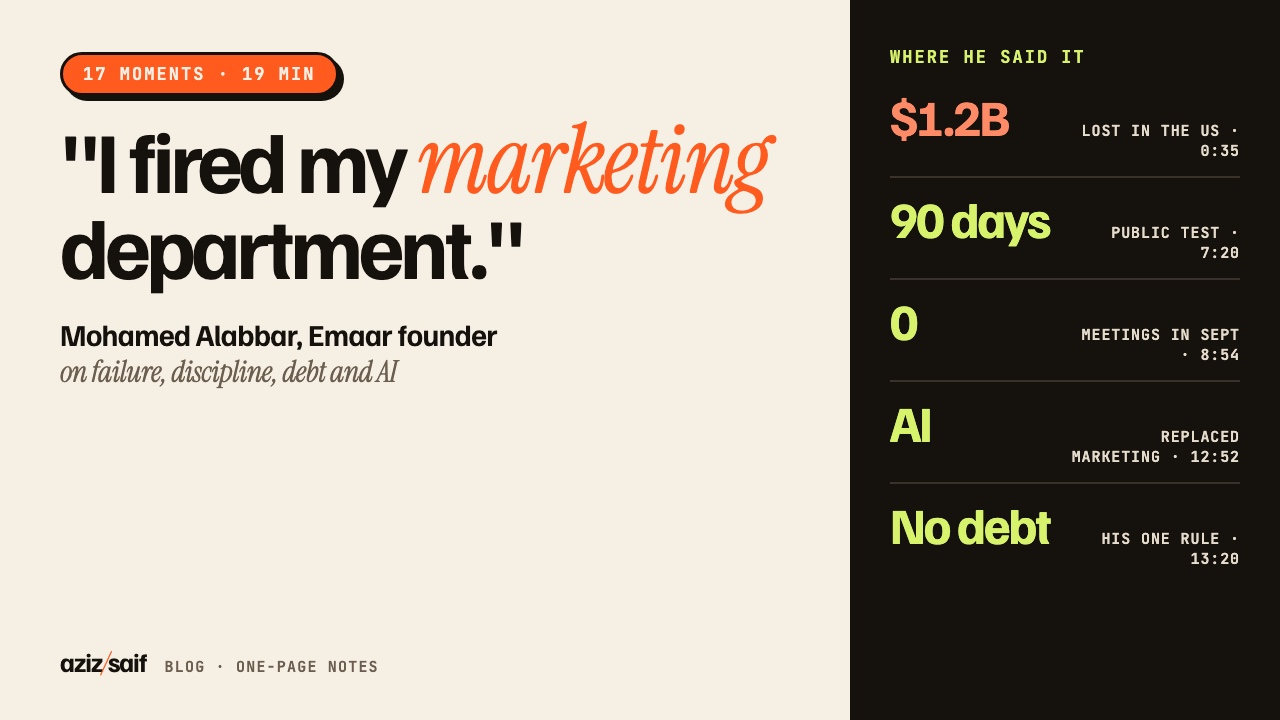
| 2 | 0:35 | Entering the US in 2005 and leaving after a $1.2B loss |
| 3 | 2:18 | How China's leadership sees the world |
| 4 | 3:43 | Politicians chasing votes instead of growth |
| 5 | 4:47 | Why success comes easy in the UAE, and why to stay humble |
| 6 | 5:49 | Berlin's 12-year snail study |
| 7 | 6:30 | Find one problem you solve better than others |
| 8 | 7:20 | Going public was his "stupid idea", and why it still helped |
| 9 | 8:54 | Flying mode: fewer people, one type of tea, no meetings in September |
| 10 | 9:41 | Being treated badly at European immigration, and Egypt's warm welcome |
| 11 | 11:10 | His joke to a NATO conference: fix Europe, the UAE is full |
| 12 | 12:52 | AI does the work, so he fired the marketing department |
| 13 | 13:20 | 1997 debt, Singapore bankruptcy, and his rule: don't borrow |
| 14 | 14:45 | A German guest asks how Europe can keep its best people |
| 15 | 16:53 | His hope that AI will one day pick the best rules |
| 16 | 17:33 | AI, autonomous delivery and white-collar jobs |
| 17 | 18:36 | The rich getting richer while others fall behind |
The business lessons
0:09 Your name is the asset
He opens with brand. A name and a reputation take decades to build and can be lost fast. He aimed this at the influencers in the room, but it applies to any business. Authenticity is what lasts.
0:35 A $1.2B lesson in America
Emaar went into the US in 2005 and pulled out after losing about $1.2 billion. He jokes that shareholders forgave him because he had made them around $70 billion.
The serious point: nobody gets everything right. You will fail badly at something. The skill is standing up after it and carrying the lesson into the next thing.
4:47 Don't confuse the market with your talent
This is the most honest part of the talk. Even with all his experience, he failed in America and is struggling in two other countries he won't name. In the UAE, clear rules, fast approvals and steady government policy make growth feel like autopilot.
His example from 5:49: Berlin is short of housing, yet the city wanted a 12-year study of the snails on a plot before he could build. He would be 85 by the time it finished.
6:30 Solve one problem better than anyone
His advice to young founders and content makers. Find a problem you can solve better than others and solve it. Emaar worked because it solved a problem that matched Dubai's growth. After that it is hard work, guarding the brand, and hiring the best people. It is a struggle, not a straight line.
7:20 Going public: the "stupid idea" that built discipline
Asked for his biggest mistake, he says listing the company. For 28 years he has reported results every 90 days. He compares it to standing naked in front of the public every quarter. Shareholders want profit up every quarter and accept no excuses, Covid or otherwise.
Then he turns it round. That pressure separates serious operators from the rest. It forces discipline and resilience, which he calls everything in business, along with brand value and a team that enjoys the struggle.
8:54 Flying mode: tighten everything
Emaar is doing very well now, and that is exactly when he cuts. Fewer people. Less of everything. The office used to serve two types of tea, now it serves one.
For the whole of September the company held no meetings and no Zoom or Teams calls. He says profit, sales and productivity all rose. If someone needs him, they phone.
13:20 Don't borrow
An audience member asks for the one financial decision behind his success. He answers with a mistake. In 1997 his retail business carried debt and nearly went bankrupt, and the Singapore operation did go bankrupt. He calls it the greatest lesson of his life.
Since then he keeps borrowing as small as possible. He avoids meeting bankers and only calls to check his deposits are safe with them. Other people borrow a billion, he says, while he borrows a tiny fraction. If you don't have the money to start a business, don't borrow it. The world is unstable, so be careful.
AI: what he is doing and what he fears
12:52 He no longer needs to call anyone
He says AI is "driving him crazy" because he no longer calls his staff, his CFO or his architects. AI gives him the answers. Last year he fired the marketing department, and he jokes the whole company may follow next year. The talk opens with the same clip.
17:33 Good news for the UAE, a warning for everyone
Hadley Gamble asks about AI and white-collar jobs. His answer has two parts.
First, AI and autonomous machines are the best news for a country like the UAE, which relies on people from abroad. At Noon, which he also founded, there are about 70,000 bike riders, and three-wheel autonomous vehicles will take over much of that work.
Second, a smart architect or lawyer who knows how to use AI will keep their job. There will still be an effect. At 18:36 he says the real danger is that the rich keep getting richer while middle and lower income people get worse off, and that everyone shares responsibility for fixing that.
His world view (his opinions, not lessons)
These parts are his personal views on politics. They are summarised here so you know what was said, not as advice.
2:18 The US and China
He says the world needs a healthy United States and a healthy China. He describes China's leaders as the top graduates who run the country seriously, more seriously than the West realises, and points to Chinese electric cars selling for a fraction of Western prices.
3:43 Votes over growth
He argues many governments make decisions to win votes rather than to grow, giving California pushing out billionaires as his example. He jokes that the UAE is happy with its own system, and recalls telling an EU conference that Europe is busy with elections while the UAE is busy with construction.
9:41 Immigration desks and a NATO joke
He describes being questioned coldly at European immigration while about to spend heavily in their hotels, and contrasts it with Egypt, where people welcome you warmly. At 11:10 he recalls telling a NATO conference that the UAE loves Europe's history, but Europe should fix its economy because the UAE is too full to take everyone. He credits the UAE's success to leadership, consistent policy and its people, and calls the country a well-run brand.
14:45 Advice to Europe
A German guest asks how Europe can stop losing its best people. He blames EU migration rules and Brussels, says leadership is what matters (he rates Italy above Germany right now), and says that if green rules stop homes being built, talented people will move to Dubai. At 16:53 he suggests AI may one day choose better rules than politicians do.
A 30-day plan from this talk
| Week | Do this | From |
|---|---|---|
| 1 | List all loans and credit lines. Pick the first to pay down. Say no to any new borrowing for growth. | Don't borrow |
| 2 | Cancel recurring internal meetings for the rest of the month. Use phone calls and short written updates. | Flying mode |
| 3 | Choose one routine function, like social posts or reports, and run it with AI. Track hours and cost saved. | AI |
| 4 | Close the month's books and review them like a listed company would. Write the one problem you solve best on the first page. | Going public, solve one problem |
FAQ
Did Mohamed Alabbar really fire Emaar's marketing department?
He said he fired the marketing department last year because AI now does that work, and joked that the whole company might be next. It opens the video and comes again at 12:52.
How much did Emaar lose in the United States?
About $1.2 billion, after entering the US in 2005. He said shareholders forgave it because the company had made around $70 billion overall.
What is his main financial rule?
Keep borrowing to a minimum. Debt nearly bankrupted his retail business in 1997, and the Singapore operation did go under. He advises not borrowing to start a business.
Why did Emaar have no meetings in September?
It was part of tightening while the business is doing well. No meetings, Zoom or Teams for the whole month, phone calls instead. He said profit, sales and productivity all went up.
What does he think about AI and jobs?
Great news for the UAE, which depends on workers from abroad. Professionals who learn AI will keep their jobs. The bigger risk is the growing gap between rich and everyone else.
Why does he call going public a mistake?
Because results must be shown every 90 days with no excuses, which he has done for 28 years. He also says that pressure built discipline and resilience.