Why choose sales as a career, and how to set goals
Anwar Barayil's fourth "Expert Talk" session for SAFI's MBA and PGDM students, recorded by the institute's media school in nine camera clips (1 h 25 min). Timestamps below refer to the joined recording. The one-page version is here; the trainer's profile, feedback scores and contact are on his page.
All the points, with timestamps
Opening
- 0:00:00 SAFI faculty welcome: 4th 'Expert Talk' session, topic Why choose sales as a career; Anwar introduced as 47–50 years in the Gulf, 3 decades in MNCs, now in his own business.
- 0:06:24 He refuses the lecture format: 'I hate classroom'. Roll-call of ~30 MBA/PGDM students by name.
- 0:09:45 Stops the session until everyone has paper and pen: 'if you came without it you are not interested'.
Who am I — the story
- 0:11:46 Ground rules: phones face-down, take notes, questions at the end, 2-hour duration, feedback form after.
- 0:14:07 50 years of learning came from FMCG majors (P&G, Mars, Gillette, Etisalat), not from a classroom. Quizzes the room on what FMCG is.
- 0:16:02 Origin: Keralite Muslim from Mahe; both parents orphans, 7 children, 4th child; days when there was no rice, only kanji. Did not finish graduation.
- 0:18:04 Went to Dubai 12 June 1977 — 2026 is his 50th year abroad. 27 years employee, 20 years businessman.
- 0:20:21 Career lesson #1: left a 7–2 Etisalat government job (~8,000 Dh with overtime) for a van salesman job at 4,500 Dh selling chocolates in 50°C heat because he saw no future. 99.9% said he was mad.
- 0:22:59 Lesson #2: took the Gillette area-sales-manager job in Riyadh at 25% less pay and sent his family to Chennai for a year — for the future, not the present.
- 0:25:10 Core message: 'Many times in life you will have to take tough decisions. Don't look at short-term losses; look at long-term opportunities. Don't listen to people.'
Why sales
- 0:26:50 Two objectives: (1) show a career that is highly rewarding but least prioritised; (2) a 'gift' — one module from his sales training that anyone can use.
- 0:27:47 Asks students their life objective. Almost everyone says 'entrepreneur' — none can say in what, or what the first step is.
- 0:31:47 'If you want to be a businessman and you are not a salesman yourself, you can't be in business.' Nobody ever says 'I want to be a successful salesperson'.
- 0:35:02 Look around the room: fan, clock, desk — every object was sold by someone. Sales is the process in between.
- 0:37:21 Why he does this free: ISR (individual social responsibility), Sadaqa Jariya, sharpening his own training skill, and building a CV of sessions for future paid assignments. He was a founding contributor to SAFI.
- 0:44:26 From thousands of interviews: 90% fail because they don't talk, don't think, aren't vibrant — 'that's what I am seeing in this room'.
- 0:41:22 You can sell a product, a service, an idea, an event, a concept (digital payments to the Indian government).
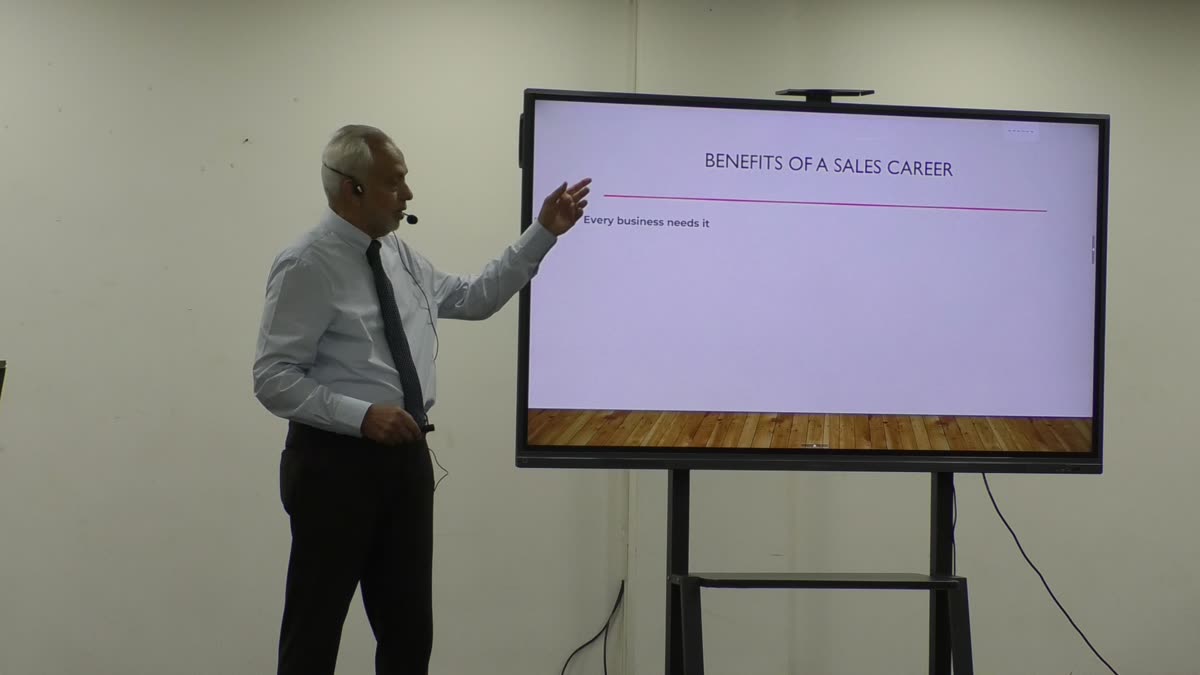
- 0:46:30 Benefits: every business needs it; skills travel (communication, persuasion, resilience); results are measurable — your numbers speak louder than your manager; sales → management → leadership → entrepreneurship is the fastest route.
- 0:51:33 The Bounty story: 12 visits over 6 months to one airport grocery that kept refusing. 'My salary is paid for the effort, not only the sale.' Resilience.
- 0:56:00 Integrity (trust is built by selling the right product truthfully) and curiosity (a crawling child grabs, bites, smells — keep that curiosity about the customer's needs).
Skills of a salesperson
- 0:58:19 Self-discipline: plan the route before leaving home; nobody is watching a salesman in the field.
- 0:59:23 Listening before communication. OVT: Obtain, Verify, Transmit — illustrated by the 'main building' mix-up on the way to this venue.
- 1:02:32 Persuasion demo with his own bag: '200 rupees, will you buy?' → No. Re-pitched to a student as the sample bag she'll need in her first sales job → the odds change. Sell benefits to a need.
- 1:04:17 Product knowledge incl. competitors (Activa vs Bajaj vs Suzuki). Features = characteristics; benefits = what it does for the buyer. First correct answer of the day.
- 1:05:43 Objection handling: real vs false objections. Prioritising: lead with the best seller (Bounty) to get into the store, then widen the range.
- 1:07:29 Closing: alternative close ('don't take 15, take the 5 fast movers') and small-commitment close ('two boxes, 60 dirhams').
- 1:09:02 Pay (via ChatGPT): India fresher 3–5 LPA, mid-level 8–10 LPA, senior ~2 lakh/month.
- 1:09:42 Gulf: 3,000–7,000 Dh entry, ~22,000 Dh sales-manager average; he knows people on 100,000 Dh/month commission. Break.
Part two — goal setting (his 'gift')
- 1:12:15 Framed on Stephen Covey's habits — begin with the end in mind. He had 2 hours of material and 15 minutes left because the students' bus leaves at 3:30.
- 1:13:37 Football analogy: remove the goal posts and 22 players just run around exhausting themselves with no sense of achievement. That's a life without goals.
- 1:14:29 Three levels: lifetime goal, long-term goals, short-term goals. Students' lifetime goals: 'be happy', 'travel and make parents proud', 'be a good person'.
- 1:16:37 A lifetime goal is a compass: if yours is heaven, you won't lie or cheat; if yours is happiness, rewrite it as 'I and everyone who deals with me is happy'.
- 1:17:47 SMART goals — 'the most important lesson of the entire course': Specific ('mobile shop on SM Street, Calicut, 10 lakhs by 2030' not 'entrepreneur'), Measurable (10 lakhs in 4 years = 2.5 lakh/yr = 22,000/month saved), Achievable-yet-challenging, Realistic.
- 1:21:11 Homework: write 1 lifetime goal, 3 long-term goals (3/5/10 yrs), 5 short-term goals; check each against SMART; align short → long → lifetime.
- 1:22:20 Write them down, post them on your desk or fridge, review often, change only if truly needed, reward yourself when you hit one, and share them with someone who will follow up.
Close
- 1:23:13 Asks students to WhatsApp/email him their goals and, at month-end, what they achieved — 'that will be the best gift to me'.
- 1:23:54 Feedback form (this is the 24-response survey, 8.1/10, already in the trainer kit).
- 1:24:42 Next step for would-be entrepreneurs: look at sales roles in structured companies, ask about pay mix, quota and growth plan, find a mentor who sells for a living.
Questions people ask
Who is Anwar Barayil?
A sales trainer and consultant based in Chennai with about 50 years in the Gulf: 27 years as an employee with Etisalat, Mars, Gillette and Procter & Gamble distributors, rising to trade marketing manager for the Middle East, then 20 years in his own business.
What was the talk about?
Why MBA students who want to become entrepreneurs should start their career in sales, which skills a salesperson needs, what sales pays in India and the Gulf, and how to set SMART goals.
What is the Bounty story?
As a van salesman in Dubai he visited one airport grocery twice a month for six months, twelve visits, and the owner refused every time because a wholesaler was two dirhams cheaper. His point: a salesperson is paid for the effort and the next visit, not only for the sale.
What are SMART goals in his version?
Specific, Measurable, Achievable yet challenging, Realistic. 'I want to be an entrepreneur' fails; 'a mobile shop on SM Street, Calicut, with 10 lakhs invested by 2030' passes, because it tells you to save about 22,000 rupees a month.
How long is the session and where is the recording?
About 1 hour 25 minutes across nine camera clips recorded by SAFI's media school on 1 November 2026. The recording belongs to SAFI; these notes were transcribed with open-source speech recognition and written up by Claude.
Full transcript
The full video and synced transcript are now on Anwar's talk page. Institutions considering the session can ask him for it directly: WhatsApp +91 98402 44034 or anwar.barayil@gmail.com.