One-Page Dashboard • August 2026
Life in America —
the class that owes
Twenty sourced facts on what an American degree now costs, who is behind on it, what the government can take when they fall behind, and what changed on 1 July 2026. Read the numbers before you read the brochures.
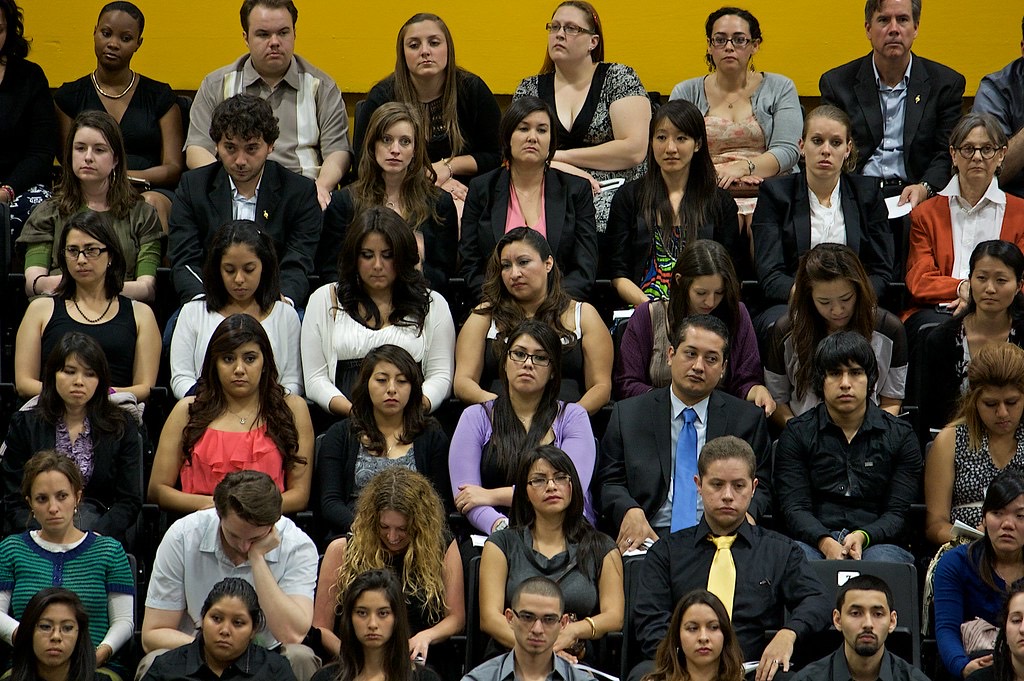
Cover: “Graduates” by Ryan Vaarsi · CC BY 2.0
Compiled 2 August 2026 · every figure carries its source
America still sells the degree as the ladder. The ledger says something more complicated: a debt pile second only to mortgages, a default count at an all-time record, a repayment system rewritten from scratch this July, and a generation postponing the house, the wedding and the children while it pays. None of this argues against studying in America. It argues for going in with the arithmetic already done.
01 — 04
The size of it
Federal Reserve · Q1 2026
Fact 01
$1.87 trillion
Owed by Americans in federal and private student loans as of Q1 2026 — up 3.3% year on year, and the second-largest category of US consumer debt after mortgages, ahead of both auto loans and credit cards.
Federal Reserve · Motley Fool
Fact 02
91% is federal
About $1.69–1.72 trillion sits with the US government across roughly 43 million federal borrowers. Private lenders hold the remaining $166.4 billion — a small slice, but the one with no income-driven safety net.
Education Data Initiative
Fact 03
$40,467 average
The average federal balance. But the median is only $24,109 — half of all borrowers owe less than that. Graduate and professional degrees, not undergraduate ones, are what drag the average up.
Education Data Initiative
Fact 04
4× in 20 years
The national total was roughly $481 billion in early 2006. It has almost quadrupled since — a faster climb than wages, tuition or inflation over the same stretch.
Federal Reserve series
05 — 08
What a seat actually costs
College Board · 2025-26
Fact 05
$45,000 tuition
Published tuition and fees at a private nonprofit four-year, 2025-26. Public four-year in-state is $11,950; out-of-state $31,880; community college $4,150. Same country, a tenfold spread.
College Board, Nov 2025
Fact 06
$65,470 / year
Full cost of attendance at a private nonprofit — tuition, housing, food, books, transport. Public in-state runs $30,990, out-of-state $50,920, community college $21,320. Multiply by four before you decide anything.
College Board, Nov 2025
Fact 07
$2,300 net
Sticker price is not the price. Inflation-adjusted net tuition at public four-years peaked at $4,450 in 2012-13 and has fallen to about $2,300 today, after grant aid. The brochure number and the invoice are two different documents.
College Board, Nov 2025
Fact 08
$6,360 vs $18,090
In-state tuition in Florida against Vermont. Community college runs $1,440 in California and $8,900 in Vermont. Choosing the state is a bigger financial decision than choosing the major.
College Board, Nov 2025
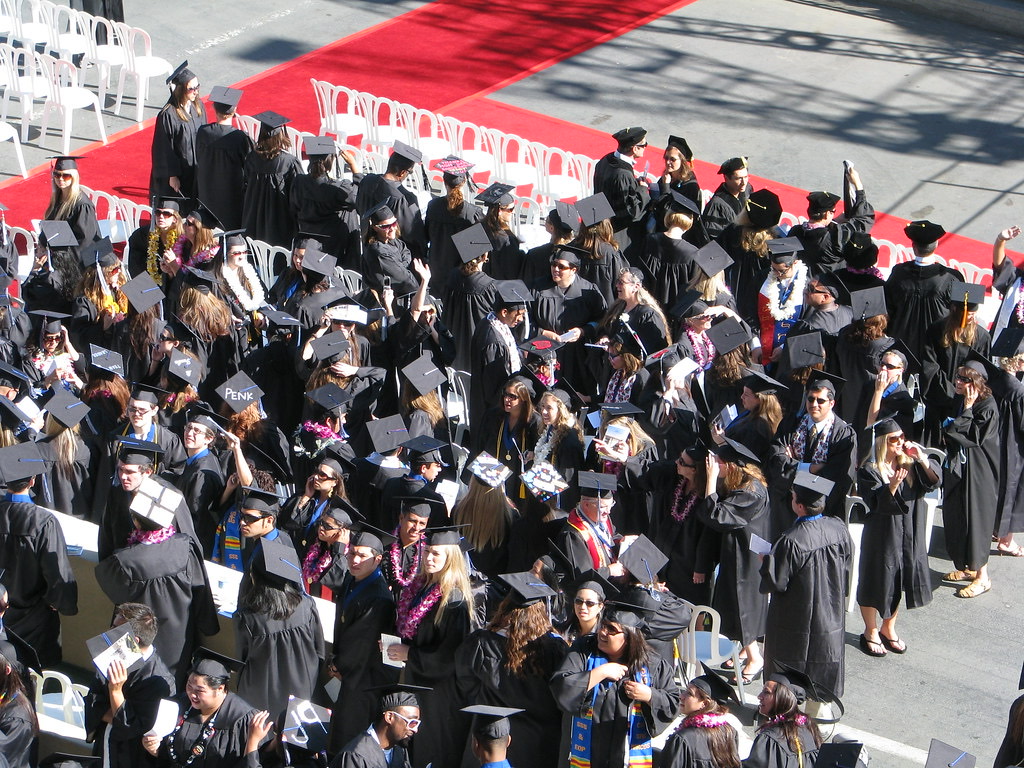
47% of the class of 2024 walked off that stage owing money — an average of $29,560 each.
Photo: “Cal State San Marcos Graduation” by Rennett Stowe ·
CC BY 2.0
09 — 12
Where it breaks
Delinquency & default
Fact 09
10.3% delinquent
Share of all outstanding student loan balances 90 or more days past due in Q1 2026, up from 9.6% the previous quarter. One dollar in ten across the whole portfolio is already late.
Federal Reserve, Q1 2026
Fact 10
~9 million in default
An estimated 1 million borrowers defaulted in Q4 2025 and 2.6 million more in Q1 2026, taking the national total to the largest number ever recorded.
The Century Foundation
Fact 11
$400bn parked
Sat inside the now-ended SAVE forbearance — an average of $60,000 per borrower. If those borrowers default at the same rate as everyone else, total distress reaches 17 million people or more.
US Dept. of Education
Fact 12
−62 FICO points
Average score drop on a new student-loan delinquency, spring 2026 — a 714 falls to 652, out of “good” into “fair.” On Credit Karma's panel, prime borrowers above 720 fell 143 points. The mark stays seven years.
FICO · Credit Karma
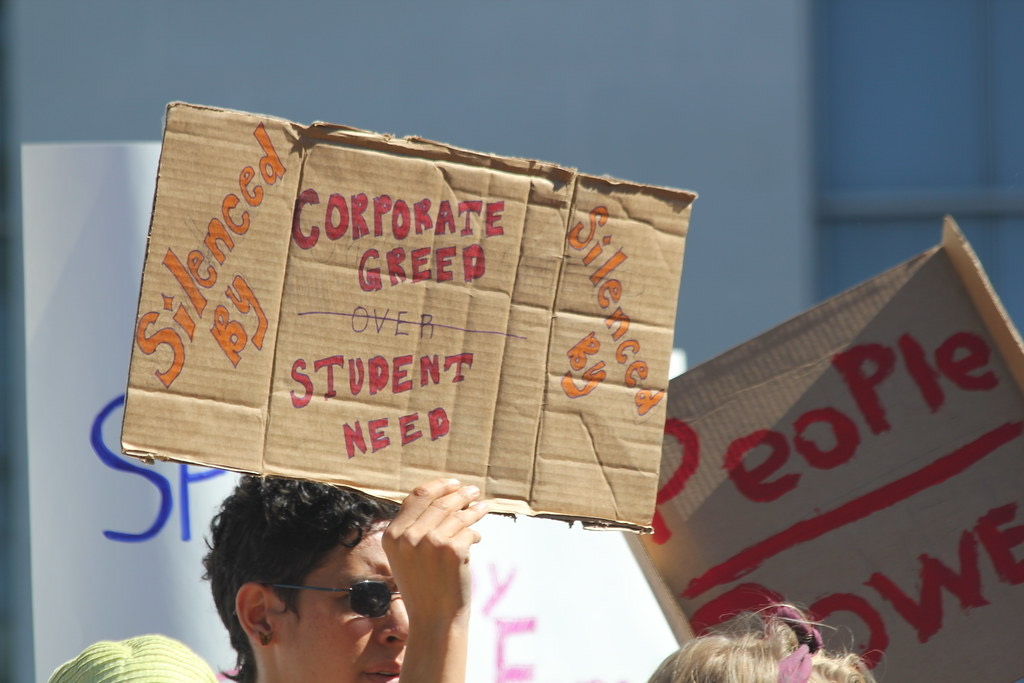
Federal student loans are one of the very few debts an American cannot walk away from in bankruptcy.
Photo: “Corporate greed over student need” by quinn.anya ·
CC BY-SA 2.0
13 — 16
What default actually does
Collections · CFPB
Fact 13
270 days
A federal loan is delinquent from the first missed day and reported to credit bureaus at 90. At 270 days it defaults — and the entire remaining balance can be called in at once, with collection fees added on top.
US Dept. of Education
Fact 14
15% of your pay
What the government may garnish from disposable wages without a court order. It can also seize the entire federal tax refund — child tax credit and earned income credit included — and offset Social Security benefits.
US Dept. of Education
Fact 15
A pause, not a pardon
Garnishment notices restarted the week of 7 January 2026. On 16 January 2026 the Education Department paused involuntary collections — with no defined end date, reversible at any time, and the new July repayment system proceeding regardless.
US Dept. of Education
Fact 16
9 in 10 harmed
Borrowers who experienced wage garnishment or a Social Security offset told the CFPB it caused significant financial hardship. And federal student debt is almost never dischargeable in bankruptcy — it follows you.
CFPB issue spotlight
17 — 20
The life it delays
NAR · NPSAS · ED
Fact 17
66% delayed a home
Borrowers who say student loans pushed back buying a house. Alongside it: 32% delayed marriage, 29% delayed having children, 40% postponed saving for retirement.
National Assoc. of Realtors
Fact 18
40 years old
The median age of a US first-time home buyer — an all-time high. 43% of them name student loans as the main obstacle to saving a down payment. Research puts each extra $1,000 of debt at ~1.8pp lower homeownership in the mid-20s.
NAR 2025 · J. Labor Economics
Fact 19
3 million aged 62+
Americans past 62 still owing federal student loans — up from 1.8 million in 2018, a 67% jump in eight years. Three-quarters of them borrowed for their own education, not a child's. The debt reaches retirement.
US Dept. of Education / WSJ
Fact 20
78.7% anxious
Share of surveyed borrowers reporting anxiety caused by their student debt; 43.5% reported hopelessness and 41.5% depression. Meanwhile about 23% of undergraduates report low or very low food security.
Borrower survey · NPSAS:20
Effective 1 July 2026
The rules were rewritten this summer
The One Big Beautiful Bill Act (Public Law 119-21) replaced most income-driven repayment plans, killed Grad PLUS, and put hard ceilings on how much anyone can borrow. If your plan was built on the old system, it is now out of date.
Two plans only
New borrowers choose between a Tiered Standard plan (10–25 years, fixed by balance) or the new Repayment Assistance Plan — 1% to 10% of adjusted gross income, forgiveness at 30 years. SAVE, PAYE and ICR are being phased out.
Grad PLUS is gone
Graduate students could previously borrow up to the full cost of attendance. Now: $20,500 a year, $100,000 aggregate for graduate study; $50,000 a year, $200,000 for professional. A $257,500 lifetime ceiling covers everything.
The MBA trap
An MBA is not classified as a professional degree under the new rules, so MBA students borrow under the lower graduate cap — not the $50,000 professional one. The list of qualifying fields is still being litigated.
Parents lose the exit
Parent PLUS is capped at $20,000 per student per year, $65,000 lifetime. Loans disbursed on or after 1 July 2026 cannot use RAP — which means no income-driven route and no path to Public Service Loan Forgiveness.
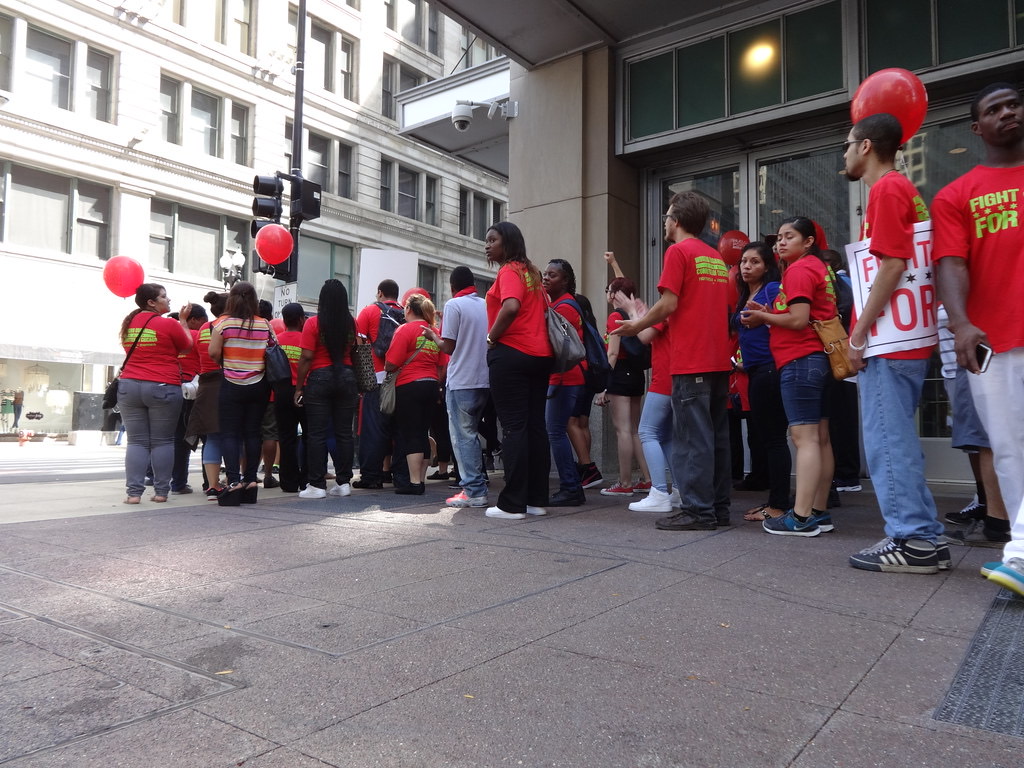
The degree was supposed to be the exit from this wage. For nine million borrowers, it became the reason they cannot leave it.
Photo: “Fast Food Workers Strike / Protest in Chicago” by danxoneil ·
CC BY 2.0
Decision Framer
So should a Gulf family send a child to study in America on debt?
Framed the way I'd frame it for a client sitting across the desk — with the assumption that the family can cover part of the cost but not all of it, and that the shortfall would be borrowed.
1 · The real decision
It is not “America: yes or no.” It is: how much borrowed money will this family put behind one 18-year-old's choice of institution, in a country where that debt cannot be discharged in bankruptcy and can be collected out of wages and pensions for life? One-way door
Enrolment is reversible. The loan is not. That asymmetry is the whole decision — and it is why this deserves more rigour than a two-way door choice would.
2 · The options
- Full-freight private US four-year, debt-funded. ~$65,470 a year, roughly $260,000 over four — the brochure route, and the one that produces the balances in Fact 03.
- Public four-year in a cheap state, in-state where possible. $30,990 a year all-in, less again after grant aid. Same accreditation, same OPT visa treatment, a third of the exposure.
- Two years community college, then transfer. $21,320 a year, then finish the degree at the four-year. The diploma names the four-year, not the community college.
- Skip the US entirely. UAE, UK, Canada, Australia, or a local branch campus — no US collections exposure at all.
3 · The three criteria that matter
- Total borrowed against realistic first-job salary. Not prestige, not ranking — the ratio. If the debt exceeds the first year's expected gross pay, the plan is fragile before it starts.
- Who signs. A parent co-signature or Parent PLUS moves the risk onto a household that is closer to retirement — and after 1 July 2026 those loans have no income-driven plan and no PSLF exit.
- Reversibility if it goes wrong. Illness, a visa change, a dropped year: what does month 13 look like if the student stops? Federal loans keep running whether the degree finishes or not.
4 · The two key unknowns
- What is the actual net price, not the sticker price? Fact 07 says the gap is enormous. Cheap to find out: run each shortlisted college's own Net Price Calculator — every US institution is required to publish one — and get written aid letters before committing to anything.
- What does this specific programme's graduate actually earn? Cheap to find out: the US Department of Education's College Scorecard publishes median earnings and median debt by field of study, by institution. Look up the exact major at the exact school. Ten minutes of work that reframes the whole decision.
5 · The honest default
Option 2 — the public four-year in a low-tuition state, with borrowing capped at one year's expected starting salary and no Parent PLUS. It keeps the American degree, the campus, the network and the visa pathway, and cuts the borrowed exposure to roughly a third of the private-college route.
The strongest case against it: for a narrow band of fields — top-tier law, elite finance, a handful of named engineering and CS programmes — the institution genuinely does change the earnings outcome, and Option 2 leaves real money on the table. That case is real. It is also far narrower than families believe, and the College Scorecard will tell you in ten minutes whether your child's specific programme sits inside it.
The main risk of the default itself: under-borrowing can force the student into 25 hours a week of paid work and a five-year degree, which has its own cost. Cap the debt, but fund the living costs honestly.
If it's genuinely too close to call: the tiebreaker is unknown #2. Median earnings by field of study at that named institution decides it — not the ranking, not the campus visit.
A note on what this page is not: it is not an argument against American education, and it is not advice to any individual. It is the ledger side of a decision that is usually sold on the brochure side. Every number above is dated and sourced so you can check it yourself — and so you can see when it goes stale.
Sources
- Federal Reserve consumer credit data via The Motley Fool — Student Loan Debt Statistics (Q1 2026 total, historical series).
- Education Data Initiative — Student Loan Debt Statistics (federal/private split, average and median balances, new borrowing).
- Forbes Advisor — Average Student Loan Debt Statistics (Q1 2026 cross-check, class of 2024 borrowing).
- College Board — Trends in College Pricing and Student Aid 2025 (published tuition, student budgets, net price, state ranges).
- The Century Foundation — the student loan delinquency crisis (default counts, SAVE forbearance exposure).
- U.S. News and Credit Karma (FICO spring 2026 score impact, prime-borrower drops).
- Yahoo Finance and ABC11 (garnishment restart and the January 2026 collections pause).
- CFPB — Social Security Offsets and Defaulted Student Loans (hardship findings, older borrowers).
- U.S. Department of Education and Harvard Student Financial Services (OBBBA loan provisions, borrowing caps, RAP).
- CBS News and The College Investor (1 July 2026 changes, MBA classification, Parent PLUS).
- National Association of Realtors, 2025 Profile of Home Buyers and Sellers, via Education Data Initiative — Student Loan Debt & Homeownership (delayed milestones, first-time buyer age).
- Journal of Labor Economics — Student Loans and Homeownership (the ~1.8pp per $1,000 estimate).
- Hope Center for Student Basic Needs — NPSAS federal data (food security among undergraduates).
- U.S. News 2026 Student Loans Survey (borrower regret, anxiety and depression figures).
Photography. All images are real photographs used under Creative Commons licences, unmodified except for cropping and compression. Cover — “Graduates” by Ryan Vaarsi, CC BY 2.0. “Cal State San Marcos Graduation” by Rennett Stowe, CC BY 2.0. “Corporate greed over student need” by quinn.anya, CC BY-SA 2.0. “Fast Food Workers Strike / Protest in Chicago” by danxoneil, CC BY 2.0.