azizsaif / Blog / Citizenship & the roll
Supreme Court · India · SIR
Citizenship is not the Election Commission’s to decide
A three-judge bench draws the boundary in open court: the Commission owns the electoral roll, not the citizen. A name struck off a list is not a citizenship cancelled.
The Dashboard
CJI Surya Kant, Justice Joymalya Bagchi, Justice Vipul M. Pancholi.
Constitution Part II plus the Citizenship Act 1955. Not the Representation of the People Act.
Off the roll is not out of the country. Deletion touches the vote, not the nationality.
Doubtful citizenship goes to the competent authority under the Citizenship Act. Until then, status quo.
The video
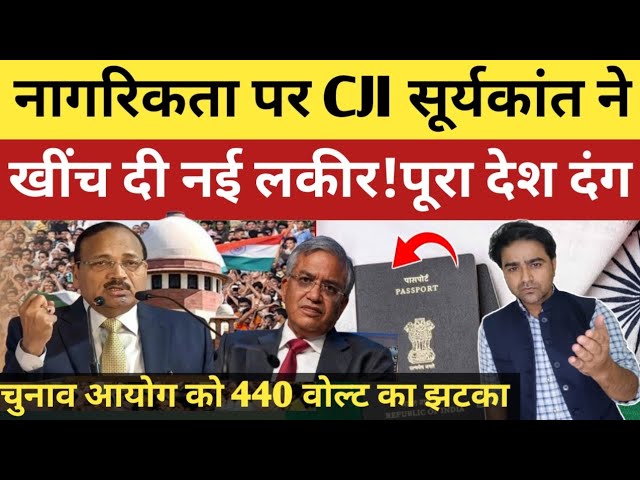
“CJI Surya Kant has drawn a new line on citizenship”
Desi TV Bharat · Hindi · 8 min 38 sec · auto-translated captions
A studio read of the hearing, aimed at the ordinary voter: passport, Aadhaar, ration card, roll — which of these makes you a citizen, and which of them never did. The digest below follows the broadcast in order; the court-order bullets after it are the load-bearing part.
What the court actually ordered
- Stay inside your boundary. The Commission is a constitutional body for elections. It is not the Home Ministry and must not conduct itself as one.
- The roll is yours. The status is not. The Commission may decide whom to include on the electoral roll. That decision does not create, confirm or cancel anyone’s citizenship.
- Exclusion strips nothing. A name absent from the roll — before or after a Special Intensive Revision — has no automatic effect on citizenship status.
- Doubt goes upstairs. Where a name is questioned on the ground of doubtful citizenship, the Commission’s duty is to place the matter before the authority competent under the Citizenship Act. It does not adjudicate it itself.
- Until then, status quo. Pending that reference and decision, the person’s existing position stands. Nobody is de-nationalised by a pending file.
- Articles 5–11 are the source. Citizenship is governed by Part II of the Constitution and the Citizenship Act. The Commission has no authority under those provisions.
- Adding names is the job. The bench’s emphasis ran the other way from the panic: the constitutional duty is to bring every eligible citizen onto the roll, not to thin it.
Timestamped digest
The decision frame
For the reader who has just found their own name missing.
1 · The real decision
Not “am I still a citizen” — the court has just answered that, and the answer is yes. The real decision is which route you use to get the name back on the roll, and how much you volunteer while doing it. Two-way door on the paperwork; closer to a one-way door on what you put in writing, because a filed declaration follows you.
2 · The options
- Do nothing this cycle. Citizenship is untouched; you simply do not vote. Costless today, expensive if the roll hardens into the default register of record.
- Ordinary inclusion. File the standard inclusion form with routine identity and residence documents. Quiet, cheap, no citizenship claim asserted.
- Contest the deletion. Appeal it as wrongly done, and put the burden on the officer to justify the strike-off. Slower; creates a record; useful if the deletion looks patterned rather than clerical.
- Full documentary build-out. Assemble the ancestry chain now, before anyone asks. Highest effort, and only worth it if the household has a genuine gap in old records.
3 · The three criteria that matter
- Does it get the name back before the next roll closes? Timing beats elegance.
- What does it commit to paper? Every declaration is permanent and re-readable by a different officer, later.
- Effort against the household, not against you. One person’s file usually drags the whole family’s records into view.
4 · The two key unknowns
- Why was the name removed? Non-submission, address mismatch and a doubtful-citizenship marking are three different problems with three different fixes. Cheap to find out: the draft roll and the deletion list are published, and the Booth Level Officer holds the reason code.
- Has any referral actually been made in your case? The order matters only if you know whether a file exists. Cheap to find out: ask the electoral registration officer in writing for the ground and any reference made.
5 · The honest default
Ordinary inclusion, filed immediately, with the reason for deletion obtained in writing first. It is the fastest route to the only thing actually lost — the vote — and it asserts nothing about nationality, which the court has just said the Commission cannot rule on anyway.
The strongest case against it: if the deletion was marked as doubtful citizenship, a plain inclusion form walks into that file rather than around it, and you may want the deletion contested and the ground put on record before you file anything else. That is the one fact that flips the default — which is exactly why unknown number one is worth a day of asking.
One line survives all of it, and it is worth keeping in plain language: a list is a list. The Commission maintains a register of who may vote. It does not maintain a register of who belongs. When those two get spoken of as one thing, the mistake is not clerical — and the court said so.
Watch the broadcast