The History Desk Mathematics & Science · Edition 01 azizsaif.com
The Formula We Forgot
The Named vs the Renamed

When Europe named it, the rest of the world had already found it

A pattern in how science honours its founders: discoveries credited to European scholars carry their names — Gauss, Euler, Bernoulli. The same insights, originating centuries earlier in Baghdad, Persia, India, China or Babylon, were renamed into anonymity.

~600+
Avg years the credit lagged the original work
6
Discoveries in this story
5
Civilizations: Babylon, Persia, India, China, Arab world
2
Concepts every student memorizes that carry no founder's name
0
Named for their non-European originator
The gaps Pythagorean theorem ~1,000 yrs Snell's law ~637 yrs Pascal's triangle ~600 yrs Calculus core ~300 yrs
A voice reads the page aloud and highlights as it goes — turn your sound on. Or tap the mic, bottom-right, to ask about any scholar.
01 — The named vs the renamed

Six examples — and who got there first

The rule is quiet but consistent: when Europe discovers it, we use the name; when the rest of the world did it first, we use a description — or someone else's name.

ConceptCredited name (West)Earlier originWhat it does
Law of CosinesGeneric name · no eponym Al-KāshīPersia · ~1427 CE — same scholar —No European eponym Solves any triangle, not just right-angled ones — generalizes Pythagoras for navigation & geometry.
Quadratic FormulaGeneric name · no eponym Brahmagupta & al-KhwārizmīIndia 628 CE · Baghdad ~820 CE — same scholars —al-Khwārizmī's work gave us the word "algebra" Every student on Earth memorizes it. Credited to no one.
Snell's LawName kept · 1621 Willebrord SnellNetherlands · 1621 CE Ibn SahlPersia · ~984 CE~637 yrs earlier How light bends through water or glass — refraction.
Pascal's TriangleName kept · 1654 Blaise PascalFrance · 1654 CE Persian & Chinese mathematicians~1050 CE~600 yrs earlier The triangle of numbers underlying probability & binomials.
CalculusName kept · 1670s Newton & LeibnizEngland / Germany · ~1670s The Kerala SchoolSouthern India · ~1350 CE~300 yrs earlier · uncredited Infinite series and the foundations of differential calculus.
Pythagorean TheoremName kept · ~530 BCE PythagorasGreece · ~530 BCE Babylonian scribesClay tablets · ~1800 BCE~1,000 yrs earlier a² + b² = c². Carved into clay long before Greece.
02 — The time gap

How many centuries the credit lagged

Each bar spans from the earliest known origin to the date the Western name took hold. A longer bar is a bigger gap between discovery and credit.

Pythagorean theorem · Babylon ~1800 BCE → Greece ~530 BCE~1,000 yrs
Snell's law · Ibn Sahl ~984 → Snell 1621~637 yrs
Pascal's triangle · Persia/China ~1050 → Pascal 1654~600 yrs
Calculus core · Kerala ~1350 → Newton/Leibniz ~1670s~300 yrs
Quadratic formula · Brahmagupta 628 CEnever credited
Law of cosines · al-Kāshī 1427 CEnever credited
4 of 6
Western eponym kept
2 of 6
Renamed to a description
0 of 6
Non-European founders honoured by name
03 — The people

The faces — real where they survive, honest where they don't

Genius came from everywhere. Below is each figure with a biography link. An honesty flag matters here: for several medieval scholars no authentic likeness survives — those images are later depictions or a page of their own manuscript, and are labelled as such.

The originators — Baghdad · Persia · India · China · Babylon
A page from Ibn Sahl's manuscript on burning mirrors and lenses.IS

Ibn Sahl

c. 940 – 1000 CE · Persia

Described the law of refraction — what we call Snell's law — around 984 CE, some 637 years before Snell.

Manuscript · no portrait existsBiography
A page of al-Kashi's Miftah al-Hisab (Key of Arithmetic).AK

Jamshīd al-Kāshī

c. 1380 – 1429 · Persia

Stated the law of cosines (still called théorème d'Al-Kashi in French) and computed π to remarkable precision.

Manuscript · no portrait existsBiography
A modern depiction of al-Khwārizmī.AK

al-Khwārizmī

c. 780 – 850 CE · Baghdad

Founder of algebra (al-jabr); the word "algorithm" comes from his name. Gave the systematic solution to quadratics.

Modern depictionBiography
A 1493 Nuremberg Chronicle woodcut used for Brahmagupta.B

Brahmagupta

c. 598 – 668 CE · India

Gave the first formal rules for zero and negative numbers, and a solution to the quadratic equation in 628 CE.

Later imaginative depictionBiography
A modern statue of Omar Khayyam at the UN in Vienna.OK

Omar Khayyam

1048 – 1131 · Persia

Worked out the binomial / "Pascal" triangle and the geometry of cubic equations — six centuries before Pascal.

Modern statueBiography
Yang Hui's triangle as printed in a period Chinese text.YH

Yang Hui

c. 1238 – 1298 · China

Published the "Pascal" triangle — known in China as Yang Hui's triangle — long before it reached Europe.

Period diagram · no portraitBiography
A modern artist's impression of Madhava of Sangamagrama.M

Madhava · Kerala School

c. 1340 – 1425 · India

Founded the Kerala school, which derived infinite series for π, sine and cosine — the core of calculus — by ~1350.

Modern impressionBiography
The Plimpton 322 Babylonian clay tablet listing Pythagorean triples.P322

Babylonian scribes

c. 1800 BCE · Babylon

The Plimpton 322 tablet lists Pythagorean triples — a millennium before Pythagoras. This is a photo of the real object.

The actual tabletAbout the tablet
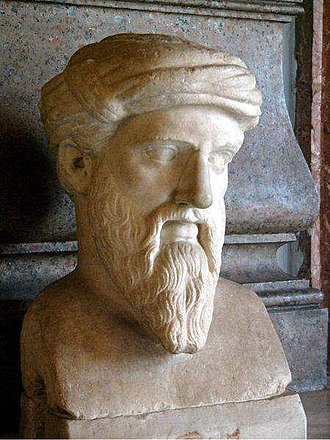
The names we kept — Europe
A Roman-era bust of Pythagoras, Capitoline Museums.P

Pythagoras

c. 570 – 495 BCE · Greece

His name is on the theorem — though Babylonian scribes carried the same rule a thousand years earlier.

Ancient Roman bustBiography
A portrait of Willebrord Snellius.WS

Willebrord Snell

1580 – 1626 · Netherlands

The law of refraction carries his name (1621) — Ibn Sahl had it ~637 years before.

Authentic portraitBiography
A portrait of Blaise Pascal.BP

Blaise Pascal

1623 – 1662 · France

The triangle bears his name (1654) — Khayyam in Persia and Yang Hui in China had it ~600 years earlier.

Authentic portraitBiography
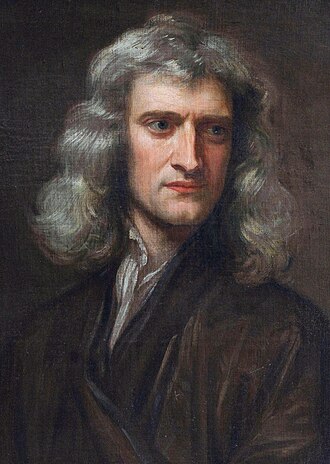
Godfrey Kneller's 1689 portrait of Isaac Newton.IN

Isaac Newton

1643 – 1727 · England

Co-invented calculus in the 1670s — the Kerala school reached its core results ~300 years earlier.

Authentic portrait · 1689Biography
Christoph Bernhard Francke's portrait of Gottfried Wilhelm Leibniz.GL

G. W. Leibniz

1646 – 1716 · Germany

Co-invented calculus and gave us its notation — the dx and ∫ every student still uses today.

Authentic portraitBiography
Every one of these was a chance to show a kid that genius comes from everywhere — Baghdad, Persia, India, China, Babylon — not just Europe.
Source & method

Where this comes from

This page is a research & history resource built from the one-page infographic "The Formula We Forgot," itself based on a video essay by Shabnam Nasimi — YouTube Shorts, "Western Discoveries vs the Rest of the World" (2025). The original infographic was designed by Perplexity.

Each figure above links to their English-language Wikipedia biography. An honesty note on the images: most ancient and medieval scholars left no authentic likeness, so several portraits here are later artistic depictions, a modern statue, or a page of the scholar's own manuscript — each is labelled accordingly. Authentic portraits exist only for Snell, Pascal, Newton and Leibniz; Pythagoras survives as an idealized ancient bust; and Plimpton 322 is a photograph of the actual Babylonian tablet. Dates are approximate where the historical record is.

From the History Desk

More history, told straight.

Field notes and research resources on history, science and the present — built to be useful, not just shared.